High-traffic properties often see their marble lose shine. Daily steps, scratches and stains dull the surface and reduce its original appeal. Many homeowners and businesses seek a dependable solution that restores both appearance and durability.
Professional restoration is a specialist service that repairs, re-levels, refines and protects natural stone so it performs and looks premium again. Specialist technicians use industry-approved methods such as diamond abrasives, polishing and sealing to revive clarity and colour depth.
London Marble Stone provides expert marble restoration services across the city, offering site inspections and free quotes before any work begins. This route is often more cost-effective than replacement and helps preserve the long-term beauty of high-value interiors.
Homeowners, landlords and facilities managers are encouraged to request a quote to assess damage and agree a practical plan that returns worn surfaces to near-original condition.
A tailored service brings tired natural stone back to life, reducing the need to lift and re‑lay complete coverings. Skilled teams assess each area, then use tested methods to revive colour, repair surface damage and improve durability.
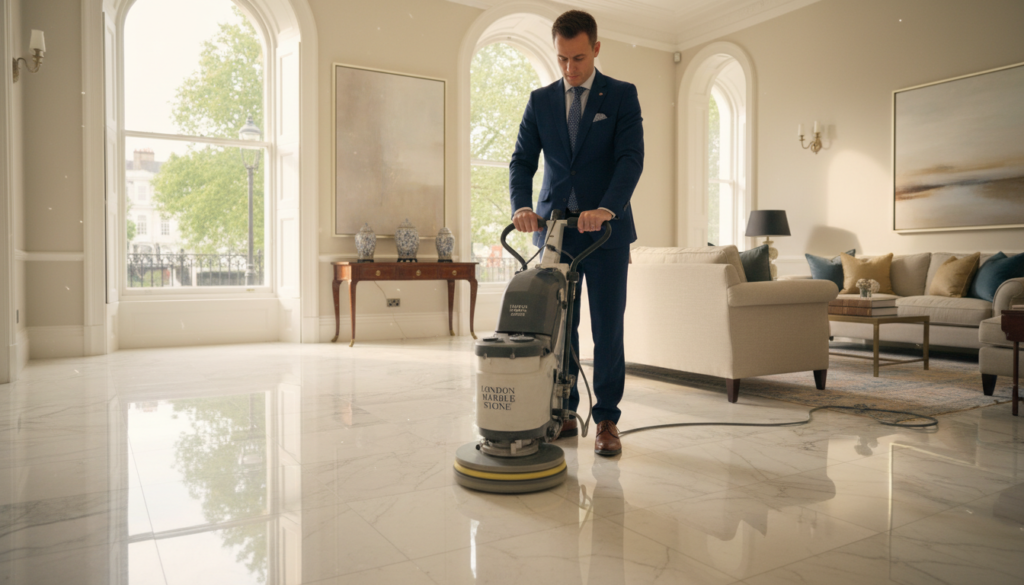
Restore, don’t replace is the practical choice for many properties. Technicians remove surface damage, rebuild the finish and apply protection. This approach usually costs less than full replacement and often adds measurable value to a property.
The service is results-led: a clear inspection, an agreed scope and controlled work that suits homes, apartments, offices and high‑use retail spaces. Clients receive a written plan and transparent pricing after the site visit.
For a clear, written quote and free site visit, London homeowners and businesses are invited to request marble restoration and stone restoration services across the city.
Everyday use and the wrong products create visible issues that demand targeted repair, not simple buffing. This short guide explains the typical faults technicians see and the correct ways to fix them.
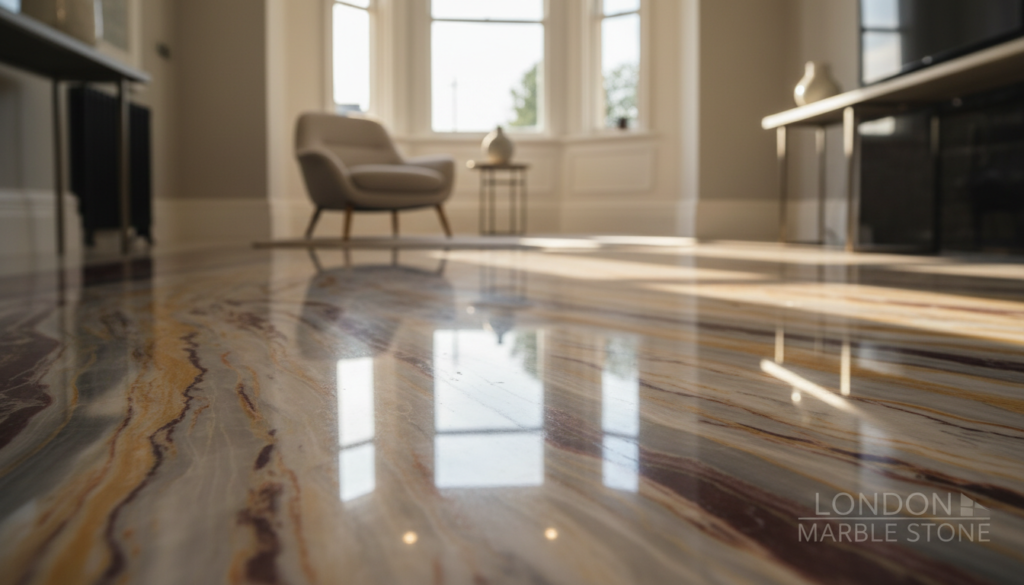
Micro-scratches from grit and poor cleaning leave a grey haze that hides natural sheen.
Residue build-up from the wrong products also masks reflectivity. Deep cleaning and diamond abrasion can recover clarity.
High-traffic routes show visible wear and aligned scratches. These “traffic lanes” need grinding or honing to remove the top damaged layer.
Etching is chemical damage. Acidic liquids like wine or citrus create dull patches that topical polishing cannot fix. Honing removes the etched layer and evens the finish.
Oils, coffee and wine cause darker marks that need poultices or stain treatments. Moisture can darken joints and edges and may require drying and sealing.
Lippage and lost grout produce an uneven walking surface. Professional levelling and re‑pointing restore a uniform plane.
| Problem | Typical cause | Professional approach |
|---|---|---|
| Dull surface | Micro-scratch, residue | Deep clean and diamond abrasion |
| Scratches/traffic lanes | High footfall, grit | Grinding and honing |
| Etch marks | Acidic spills | Honing to remove etched layer |
| Stains | Oils, coffee, wine, moisture | Stain treatment and sealing |
| Uneven tiles | Lippage, worn joints | Levelling and re-pointing |
For those seeking specialised polishing and repair, see the detailed polishing and repair services that match each problem to the right treatment.
Work starts with a careful inspection that establishes the stone’s condition and the most suitable treatment sequence.
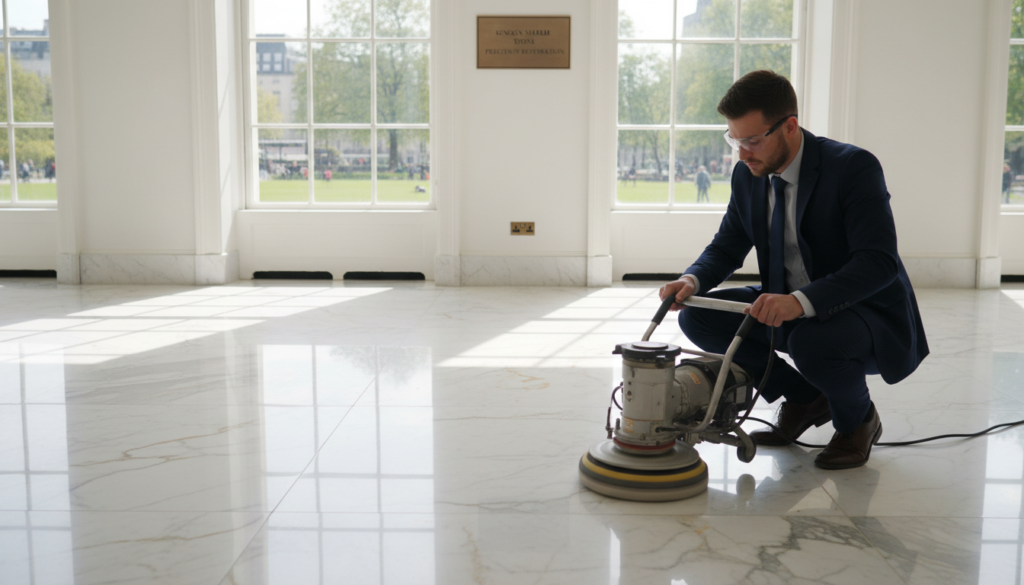
Technicians assess etching versus scratches, check joints and lippage, and confirm the desired finish from satin to high‑gloss. A custom plan sets the techniques and abrasive progression based on stone type, wear and area footfall.
Surfaces are cleaned to remove build-up and residues using neutral products. This protects the substrate and avoids further etching.
For heavy damage, diamond abrasives progressively cut back the surface to re‑establish flatness. This step corrects uneven tiles and worn joints and restores plane before refining.
Honing removes etch marks and light scratches to achieve a consistent satin or matte finish. Polishing then restores clarity and colour depth using the correct pads to avoid haze.
Protection follows: impregnating sealers reduce porosity and help prevent future staining, simplifying ongoing maintenance.
Technicians inspect reflections, edges and transitions to confirm quality results. They supply practical aftercare advice on cleaning products, matting and a maintenance schedule to prolong the finish and protection.
| Stage | Purpose | Typical time |
|---|---|---|
| Inspection & plan | Assess condition and agree finish | 30–60 minutes |
| Cleaning & prep | Remove residues safely | 1–3 hours |
| Diamond grinding | Remove heavy damage and level | 1–8 hours (area dependent) |
| Honing & polishing | Refine finish and restore shine | 2–6 hours |
| Sealing & checks | Apply protection and final QA | 1–2 hours |
A clear assessment separates cosmetic polishing from the deeper grinding and levelling that heavy wear requires.
Polishing is a finishing step. It restores shine and clarity when the stone is flat and only lightly worn.
Honing is needed where etch marks or widespread dull patches exist. It removes a thin damaged layer before polishing can work.
Full corrective work—grinding and levelling—handles deep scratches, lippage and heavy traffic patterns. After that, technicians refine the surface to the chosen sheen.
Satin or matte finishes suit understated interiors and improve slip resistance. High-gloss gives strong reflection for feature areas.
| Service | When to choose | Typical outcome |
|---|---|---|
| Polishing | Flat, lightly worn surface with minor haze | Improved shine and clarity; quick turnaround |
| Honing | Etch marks or uneven dull patches | Evened surface ready for polishing |
| Full restoration | Deep scratches, lippage, heavy traffic wear | Leveled plane, uniform sheen from satin to high-gloss |
London Marble Stone advises a site inspection to confirm the correct level of work and to avoid unnecessary processes.
Different settings need tailored attention so natural stone keeps its colour and stays safe under use.
In residential flats and houses, daily wear, accidental spills and pet traffic cause dulling and stains. Renovation projects also prompt refresh work so surfaces match updated interiors.
Services for homes usually focus on stain removal, etch repair and a quick turnaround to reduce disruption to residents.
Businesses need a professional appearance with minimal interruption. Teams schedule after-hours work and clear access plans so staff and clients are not disturbed.
Entrances, retail aisles and busy routes demand durable results and even, safe surfaces. High-footfall areas often need phased work to cover large areas without closing the site.
Many providers restore mixed schemes that include granite, limestone and terrazzo alongside marble. They plan scope and time carefully, agree drying windows for sealers and deliver predictable results.
| Property type | Typical driver | Common work |
|---|---|---|
| Homes & apartments | Daily wear, spills, renovations | Cleaning, honing, sealing (short time) |
| Offices | Professional look, minimal disruption | After-hours polishing, phased access |
| Commercial | High footfall, safety, durability | Grinding, levelling, durable sealers |
Restoring each room starts with a practical assessment of use and damage. Treatments are chosen to match wear patterns so the finished surface looks uniform and is easier to maintain.
In kitchens the focus is stain management for oils, food and coffee. Technicians remove etches from acidic spills and blend heavy‑use zones near sinks and hobs to restore a consistent surface.
Hallways show traffic lanes and grit-related scratches. Correct grinding and polishing re-establish an even sheen from edge to edge for a cleaner overall look.
Living areas often act as feature spaces. Skilled work returns clarity and uniformity so the stone becomes a focal point under natural and artificial light.
Entrances need strong protection and safety. Levelling repairs lippage and sealing reduces porosity to help guard against everyday spills while improving durability.
A trained team with the right kit delivers predictable repairs and a finish that DIY rarely matches.
Domestic polishers and abrasive pads are not designed for sustained, controlled cutting. Incorrect pads or cleaning chemicals can etch the stone, cause swirl marks or leave an uneven sheen.
Professional machines use staged abrasive sequences and purpose-built discs to remove damage gradually. This prevents over‑cutting and preserves original colour depth.
Skilled operators manage levelling, edges and joints so the whole plane looks uniform. That consistency prevents visible traffic lanes and reduces the need for repeat repair.
Good technique avoids the tell-tale swirl marks and patchy gloss that DIY kits often leave behind.
After corrective work, technicians apply specialist sealers that reduce porosity and improve stain resistance. This protection makes daily cleaning easier and extends the time between professional services.
The same team commonly covers stone restoration for worktop surfaces, thresholds and interior details, so one service can repair multiple elements without compromise.
| Issue | DIY outcome | Professional outcome |
|---|---|---|
| Scratches and traffic lanes | Patchy shine, possible swirl marks | Even levelling, uniform sheen |
| Etch marks and spots | Surface masked but not fixed | Honed away then polished and sealed |
| Sealing and protection | Inconsistent or absent protection | Controlled sealing, lower porosity |
An expert inspection turns uncertainty into a defined scope, timetable and predictable outcome. Professional stone restoration fixes dullness, scratches, etching, stains and uneven tiles to return surfaces to a cleaner, more refined finish.
The combined approach of correct cleaning, controlled abrasion, refined finishing and protective sealing improves both appearance and long‑term durability. Polishing suits light wear; deeper damage needs full restoration to ensure a uniform result.
Suitable for homes, offices and busy commercial entrances, a planned service matches treatment to footfall and expectations. London Marble Stone provides expert marble floor restoration across London and offers free quotes based on stone type, condition and area size.
Request a quote to confirm the right scope, expected finish and timeframe. Professional stone care also protects property value and keeps granite and other surfaces easier to maintain.
The team restores a wide range of natural stone surfaces including marble, granite, limestone and terrazzo. They work on residential and commercial surfaces such as worktops, bathroom floors, entrance lobbies and high-traffic retail areas, using techniques tailored to each stone’s condition.
A technician conducts an on-site inspection to assess wear, scratches, etching and staining. They then provide a tailored treatment plan outlining cleaning, diamond grinding or honing where needed, followed by polishing, sealing and maintenance advice, plus a transparent quote for the work.
Restoration can resolve dull, tired surfaces caused by incorrect cleaning, remove scratches and traffic patterns, eliminate etch marks from acidic spills, lift oil and coffee stains, and correct uneven floors, lippage and worn joints through levelling.
Polishing is suitable for light wear and to reinstate sheen on otherwise sound stone. Full restoration, including diamond grinding and honing, is required for deep scratches, severe etching, significant staining or uneven tiles that need levelling to achieve a consistent finish.
Duration depends on the area size and severity of damage. Small rooms can be completed in a day, while larger commercial projects may take several days. The provider will give an estimated timescale during the initial survey and schedule work to minimise disruption.
Properly executed honing and polishing restore clarity and colour depth rather than change it. Technicians can achieve different finishes from satin to high-gloss depending on client preference and the stone type. Any expected variation is discussed before work begins.
Diamond abrasives are industry standard for safe and effective grinding and levelling. Technicians select appropriate grit sequences and pressures for each stone to avoid overworking the surface and to ensure consistent results without swirl marks or damage.
Stains are treated with specialised poultices and cleaning agents matched to the stain type and stone. Etch marks from acidic spills are removed by honing to re-level the surface, then polished to restore the finish. Persistent stains may require repeat treatment or localised intervention.
Sealing is recommended to reduce porosity and future staining. Technicians apply high-quality impregnating sealers that protect against oil and moisture ingress while allowing the stone to breathe. Aftercare guidance and maintenance products are usually provided to prolong results.
Yes. Teams plan work to minimise disruption, often working in stages or outside peak hours for offices and retail spaces. Dust control and protective measures are used to keep adjacent areas clean and safe during the process.
With correct sealing and regular care, restored surfaces can remain attractive for years. Routine maintenance includes using pH-neutral cleaners, avoiding acidic products, prompt spill cleanup and periodic re-sealing. The provider can advise a maintenance schedule suited to the area’s use.
Yes. Restoration teams handle homes, apartments, offices and commercial properties such as retail entrances and hotel lobbies. They tailor techniques and scheduling to meet each client’s needs and the demands of high-footfall areas.
After the site inspection, clients receive a written quote detailing proposed treatments, materials, timescales and costs. This transparency helps compare options such as simple polishing versus full restoration with diamond grinding and levelling.
Clients should avoid using abrasive pads, acidic cleaners or DIY sealers on affected areas. Clearing furniture and fragile items from the work area helps speed the process. Specific pre-visit instructions will be provided with the booking confirmation.
Many professional providers offer workmanship guarantees and aftercare support, including advice on maintenance and options for scheduled inspections or re-sealing. Clients should confirm guarantee terms and any follow-up services when accepting the quote.