
Etch Mark Removal Marble London introduces a dedicated service for homeowners and businesses who find dull patches or cloudy spots on polished marble surfaces.
These blemishes often come from acidic liquids such as lemon juice, vinegar, food spills and harsh cleaning products. They interrupt reflection and depth of colour on floors, worktops and tiles.
The solution usually needs more than household cleaners. A controlled approach uses inspection, deep cleaning, specialist abrasives, and honing followed by polishing. This professional marble process restores shine and a smooth finish without replacement.
Professional restoration revives the stone, improves durability and is often more cost-effective than buying new surfaces. Reputable providers offer a clear service pathway from initial inspection to a final quality check and commonly provide free quotes.
London Marble Stone offers London-wide coverage and free quotes for etch removal and polishing, giving property owners a repeatable, trustworthy route back to a consistent finish.
A professional inspection reveals whether a surface needs light honing, deeper abrasion, or full polishing. Trained teams create a tailored plan that suits domestic kitchens, bathrooms and hallways as well as commercial receptions, shops, bars and offices.
Clients receive an on-site survey and a clear, written plan. Technicians explain controlled use of diamond abrasives and polishing pads and set realistic timescales. Many residential jobs finish within a couple of days; larger commercial projects may take several days depending on scale and footfall.
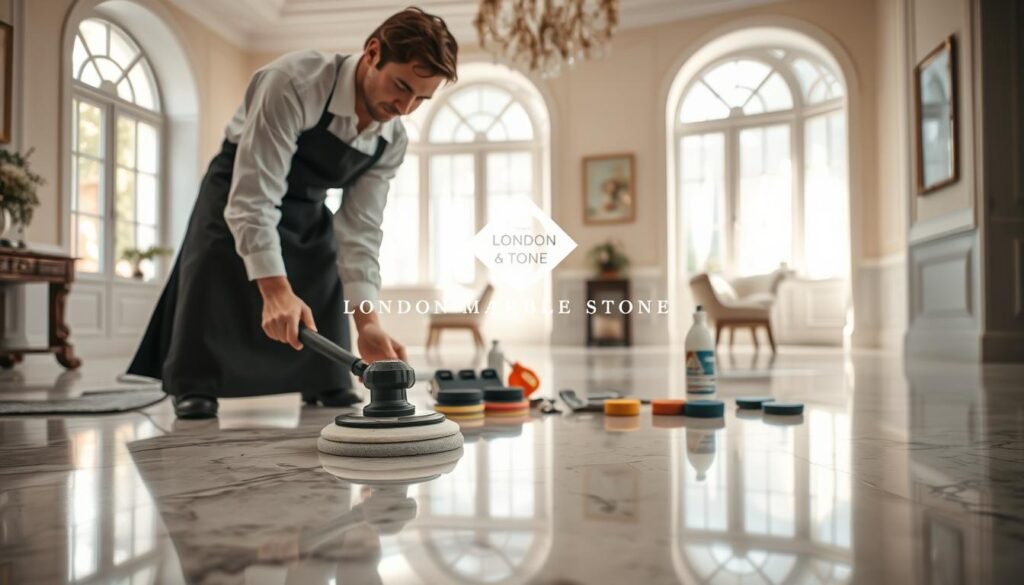
Professional marble restoration avoids the expense and disruption of replacing stone, matching tiles or regrouting. Specialist teams use correct tooling and chemical choices to protect the surface. With proper work, restored stone improves property appeal and sustains a premium look for customer‑facing areas.
| Service | Typical time | Benefit |
|---|---|---|
| Small domestic repair | 1–2 days | Fast, low disruption |
| Large floor restoration | 3–7 days | Uniform finish across high traffic areas |
| Commercial refinish | Variable, staged work | Maintains brand impression and safety |
Cloudy patches on polished stone often show as pale rings or shadowy spots that refuse to reflect light.
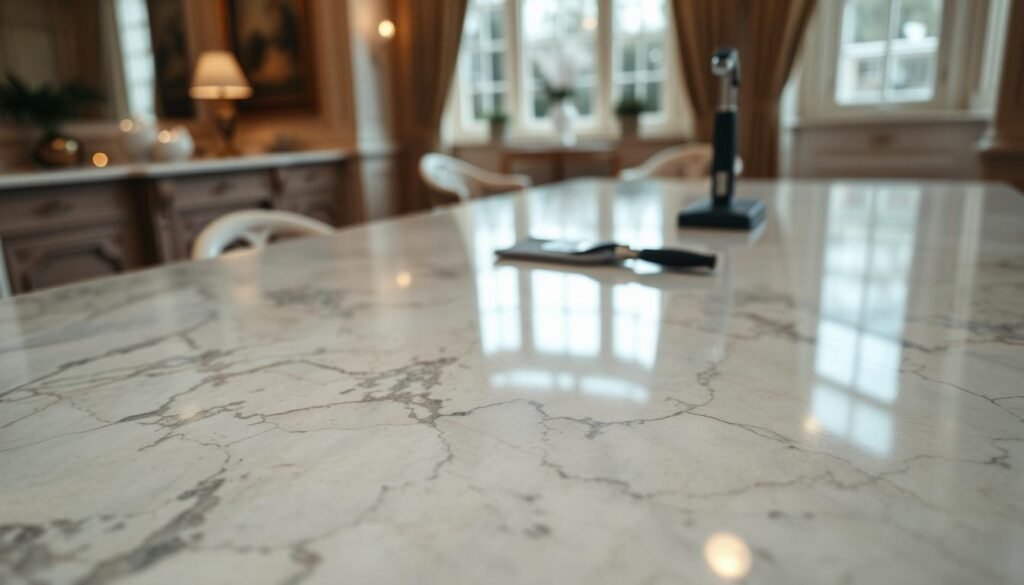
Everyday acids—citrus juice, vinegar-based sprays, wine or fruit spills—attack the polished face of the stone. Harsh cleaning products or acidic toiletries left to dwell can also worsen the finish.
In kitchens this appears after an accidental squeeze of lemon on a worktop. In bathrooms it follows contact with soap scum remover or acidic cosmetics.
A polished surface owes its shine to a microscopically smooth layer that reflects light evenly. Acid reacts with the mineral, dulling that smoothness and creating a matte patch.
Wiping does not restore the gloss. Even when the spill is removed, the surface has changed chemically and physically, so the pale area remains.
Quick care steps
| Visual sign | Typical cause | Immediate action |
|---|---|---|
| Cloudy rings or pale patches | Citrus, vinegar, wine, fruit acids | Blot spill; rinse with water; call a stone specialist if glaze lost |
| Matte, shadowy areas | Acidic cleaners or cosmetics | Stop product use; clean with pH-neutral solution; inspect finish |
| Subtle bloom on honed finish | Light acid contact or residue | Gentle cleaning and professional refinement to match finish |
For guidance on safe products and routine cleaning, see cleaning marble countertops and tiles, which outlines pH-neutral care and best practice.
Visible damage to a stone finish can take three common forms, each needing a different repair route.
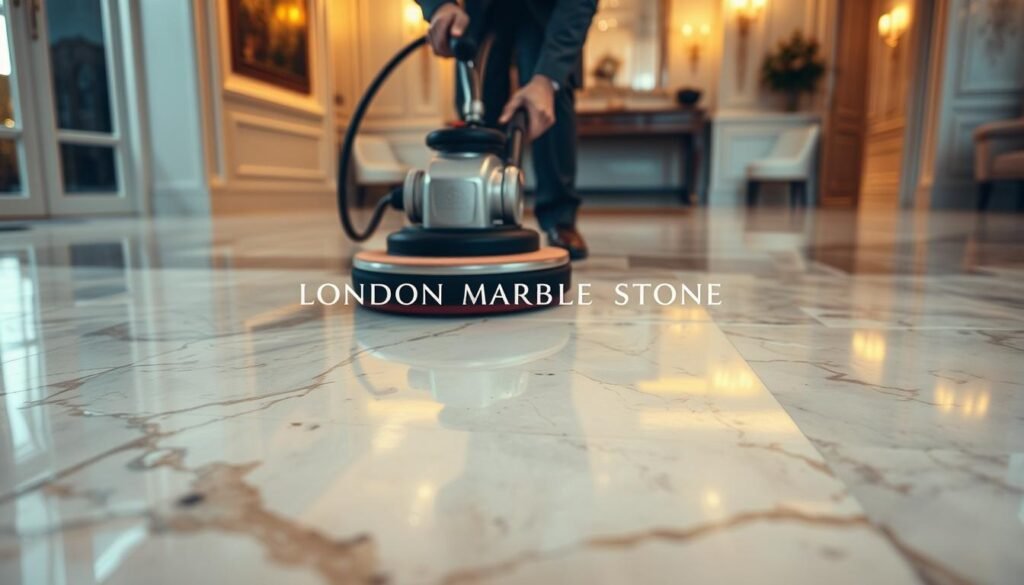
Etching appears as a dull, light-diffusing burn on the polished face. It is a change to the surface itself and not simply a deposit that regular stone cleaning will shift.
Scratches are physical lines or grooves. They often respond to progressive abrasion and honing to blend the area with surrounding stone.
Stains show as colour change within the stone and need targeted extraction methods. Limescale or soap deposits usually require safe descaling suitable for natural stone rather than aggressive acids.
Polishing is required whenever the aim is to restore clarity, reflection and an even gloss. Specialists assess finish level, damage depth and whether a local repair will create a visible patch.
| Problem | Appearance | Typical treatment |
|---|---|---|
| Stains | Discolouration within the stone | Targeted poultices or chemical extraction |
| Scratches | Lines or grooves on the face | Progressive honing; fine polishing to match sheen |
| Etching | Dull, matte patch that scatters light | Honing then marble polishing to restore gloss |
Professional teams aim to preserve as much original material as possible while using the correct process to restore marble to a uniform, consistent look.
Daily life in compact city homes exposes worktops and vanity tops to foods, drinks and cleaning agents that attack polished stone. Frequent use and close quarters mean a single spill or the wrong spray can affect a visible area quickly.
Kitchen counters see citrus, vinegar, sauces and cocktail mixers. Bathroom surfaces meet soaps, cosmetics and limescale sprays. These items are common triggers and they accumulate fast in busy homes and rented flats.
Compact layouts and regular entertaining increase exposure. High-throughput bathrooms and small galley kitchens raise the chance of repeated contact with damaging substances.
Well-meaning cleaning can harm stone. Acidic bathroom sprays, bleach mixes and scouring pads remove the polished surface rather than restore it.
Inexperienced cleaners or some commercial teams may use aggressive chemicals and abrasives. This can permanently dull the finish and raise future restoration costs.
When multiple dull patches appear, a professional assessment is recommended. Repeated spot attempts risk uneven results; controlled honing and polishing by specialists is the most reliable route back to a uniform finish. For guidance on careful restoration and specialist services see stone surface etch guidance.
Restoration begins with a technical assessment. The team records stone type, current finish, distribution of damage, traffic patterns and any prior coatings or lippage. This defines the custom restoration process and expected timescale.
Technicians inspect for finish level (polished or honed), depth of wear and uneven joints. They note whether full-panel work is needed to avoid a visible patch repair.
Deep stone cleaning removes residues so abrasives cut evenly. Proper cleaning prevents dragging grit that can scratch the surface during refinement.
Honing uses progressive diamond grits (commonly 100–400) to remove dull areas and light damage. The aim is a smooth, even surface ready for finer polishing.
Polishing advances through finer grits (for example 800–1500) and polishing pads to bring back reflection and depth. Professionals blend repairs to match surrounding finish and avoid visible transitions.
Where tiles are uneven or wear is deep, grinding and levelling remove lippage before honing. A final quality check confirms uniform sheen, no swirl marks and a finish suited to the client’s use.
| Step | Typical tools | Outcome |
|---|---|---|
| Inspection | Visual survey, moisture and coating tests | Custom treatment plan and scope |
| Honing | Diamond pads 100–400 grit | Removes dull damage and levels light defects |
| Polishing & final check | Finer diamonds 800–1500, polishing pads, finish tests | Restored gloss, matched finish, client sign-off |
High footfall areas show gradual loss of gloss that appears as broad, worn lanes rather than single spots. Specialists treat these larger zones to avoid patchy results and to restore an even surface across open-plan spaces.
Daily use creates traffic lanes, entrance wear, chair movement marks and dulling from repeated mopping. These often show as multiple cloudy zones rather than one ring.
Technicians assess whether honing with diamond abrasives is enough or if grinding and levelling are needed to correct uneven joints.
Polishing and marble polishing remove light abrasion, blend repairs and bring back a consistent shine. Proper work also reduces the visibility of scratches and restores depth to the stone.
After restoration, use pH-neutral cleaners, avoid acidic floor refreshers and rinse well. Keep tracked-in grit low with mats and regular sweeping to protect the finish.
| Issue | Professional action | Benefit |
|---|---|---|
| Traffic lanes & cloudy zones | Honing with diamond pads; blending full panels | Uniform appearance across floors |
| Uneven tiles or lippage | Grinding and levelling before honing | Flat floor; seamless polishing |
| Ongoing wear | Targeted polishing and maintenance plan | Brighter rooms and longer-lasting shine |
Wall cladding and tiled areas need a more cautious touch than freestanding worktops because edges and joins make any mismatch obvious.
Careful assessment starts with testing the existing sheen on each tile. Technicians note colour and reflectivity across several panels before any work begins.
A controlled sequence of honing and polishing is chosen to match the surrounding finish. The team uses progressive abrasives and trials on a spare or hidden area to avoid visible differences.
Edges and grout require delicate handling to prevent rounding or “picture framing”. Specialists work up to trims with fine tooling and hand-finishing where needed.
The aim is uniformity: restored stone should read as original, not a local repair. Correct tooling and technique reduce swirl marks and keep vertical and tiled surfaces consistent.
| Challenge | Action | Outcome |
|---|---|---|
| Varying tile sheen | Sheen testing and matched polishing | Even appearance across tiles |
| Grout and edges | Hand detailing and precise tooling | No rounded or framed look |
| Colour and reflectivity | Cross-tile assessment | Seamless, original-looking surface |
Wet rooms routinely expose polished surfaces to personal care items and heavy cleaning routines. This makes certain stone finishes prone to dull patches after repeated contact with acidic or harsh products.
Common bathroom scenarios include toothpaste residue, cosmetic spills, perfume, limescale sprays and shampoo left on vanity ledges or shower shelves. These residues and routine sprays can react with the surface and scatter light.
Frequent cleaning cycles, damp conditions and product build-up push owners to use stronger descalers. Such chemicals are often unsuitable for delicate stone and worsen dulling.
Specialist teams remove dull areas with careful honing and then polish to a sheen level chosen for daily wear. The aim is to restore clarity while leaving a finish that copes with normal bathroom use.
Practical advice: avoid acidic descalers on these surfaces, use stone-safe cleaning products and rinse accidental spills promptly. A good sealer can reduce porosity and staining in wet zones, but it will not prevent acid contact from dulling a polished finish.
| Scenario | Professional action | Practical note |
|---|---|---|
| Toothpaste, cosmetics | Local honing and polishing | Quickly rinse to reduce repeat damage |
| Limescale sprays, descalers | Deep clean with stone-safe agents | Replace acids with neutral alternatives |
| Shampoo/perfume residues | Surface refinishing and sealing | Sealers help stains but not acid etching |
Busy kitchen counters and crowded bar tops face direct contact with acidic spills and food residues that quickly dull a polished work surface.
Professionals assess whether a local repair will blend or if a full surface refinish is needed to secure an even sheen. Choice depends on size and depth of the damage, the overall wear and the existing finish.
Spot repairs suit shallow, isolated damage. They remove the dull area and polish it back to level.
However, isolated polishing can create a visible halo when the surrounding worktop shows different wear or sheen. For that reason, teams recommend a larger panel or full resurfacing when uniformity is essential.
| Approach | Best for | Outcome |
|---|---|---|
| Spot repair | Small, shallow damage | Faster, lower cost; may show slight sheen variation |
| Whole-surface refinishing | Widespread wear or mixed sheen | Consistent finish across the whole work area |
| Panel blending | Moderate area of wear | Balanced result with less visible transitions |
After polishing, technicians commonly apply an impregnating sealer to reduce porosity and help prevent stains from coloured liquids.
Important expectation: sealers assist with staining but do not stop acid contact from dulling a polished surface. Quick wipe-ups and stone-safe cleaning products remain essential in busy kitchens and bars.
Fixing a polished surface requires more than elbow grease; it needs diagnostic skill and specialist machinery. General cleaning teams rarely have the training or the tools to assess whether a dull area is a surface etch, a stain or a scratch.
Experts use measured abrasive progressions and diamond pads. They combine hands-on experience with testing to choose the least invasive route. This preserves more of the original surface and reduces long-term cost.
Many non-specialist cleaners reach for strong chemicals or coarse pads to “brighten” a surface. That approach can deepen dulling and create visible unevenness, forcing more extensive honing later.
Restoration services protect the value of premium stone. Using trained professionals and correct stone cleaning methods reduces repeat work and keeps surfaces looking their best.
Applying a sealer is a practical step that reduces how quickly liquids soak into polished stone. It forms an invisible barrier below the surface and helps make routine maintenance easier.
Impregnating sealers penetrate pores rather than sit on top. One or two coats are common on polished stone and they slow the absorption of staining liquids.
Annual reapplication keeps protection effective, particularly on busy counters and wash areas.
Important: sealers are not an acid shield. Citrus, vinegar and other acidic cleaners can still dull a finish and cause marble stains even when sealed.
Clients should view sealing as stain management and ongoing maintenance, not a guarantee against dulling.
| Action | Effect | Frequency |
|---|---|---|
| Impregnating sealer (1–2 coats) | Reduces porosity; helps resist stains | After restoration; reapply annually |
| pH-neutral cleaning | Safe routine maintenance; preserves gloss | Daily/weekly as required |
| Avoid acids & abrasive pads | Prevents new dull spots and marble stains | Always |
London Marble Stone provides professional marble restoration services across the capital and offers free, no‑obligation quotes for domestic and commercial jobs.
The team covers all areas and handles work from single worktops to large floor programmes. They use experienced operatives and industry tooling to assess condition and recommend the correct course of action.
Clients should supply location details, clear photos of the affected area, approximate dimensions and the stone type if known. Adding the preferred finish (polished or honed) and any history of previous treatments helps the expert price and plan accurately.
Many residential jobs complete within a couple of days. Larger floors or multi‑room commercial work may take several days where blending, levelling or staged access is required.
| Factor | Influence on work | Typical outcome |
|---|---|---|
| Area size & traffic | Determines time and cost | From a few hundred to thousands of pounds |
| Depth & spread of damage | Local repair or full panel blending | Spot repair or whole‑area refinishing |
| Access & prior treatments | Affects preparation and tooling | May extend timetable for safe restoration |
Request a free quote to receive a written estimate that records condition, describes proposed work and gives a fixed price. That ensures clarity before any restoration begins.
Surface dulling from acids is a physical change that requires specialist honing and polishing to correct. Plain cleaning rarely restores gloss. A professional approach protects original material and saves the cost of replacement.
The proven pathway is clear: inspection, safe preparation, progressive honing, polishing to restore colour and shine, then sealing where appropriate. Trained teams diagnose whether a blemish is a surface issue, a scratch or a deep stain to avoid unnecessary work or damage.
These expert services cover floors, tiles and walls, bathrooms and worktops for homes and businesses. London Marble Stone provides professional marble etch mark removal across the city and offers free quotes—request an assessment to restore your stone with confidence.
A professional team carries out a careful inspection, explains the likely causes of dull spots or surface damage, and recommends a targeted plan. Typical steps include deep stone cleaning, honing with diamond abrasives to remove surface etching and light damage, followed by polishing to restore gloss and colour depth. Technicians use industry-proven methods and tools to protect adjacent surfaces and ensure a uniform finish.
Repairing and refinishing existing stone preserves material, avoids demolition and reinstallation costs, and typically takes less time than full replacement. Skilled restoration recovers aesthetics and performance, extending the life of floors, worktops and bathroom surfaces while keeping disruption and expense far lower than new stone.
Etching appears as a loss of sheen rather than a stain. Acids in lemon juice, vinegar, some cleaning products and food can react with polished stone, dissolving the microscopic surface layer and leaving a matt, greyish mark that scatters light instead of reflecting it.
Everyday items—citrus, wine, vinegar-based cleaners, tomato products and certain toiletries—can etch polished stone. Regular spill exposure in high-use zones such as kitchens and bathrooms increases risk, especially if spills are wiped with abrasive pads or strong chemical cleaners.
Etching is surface damage affecting the finish and shine. Stains change the stone’s colour from substances penetrating the pores. Scratches physically remove material and create grooves. Each requires a different treatment: cleaning and poultices for stains, honing and polishing for etches, and grinding or filling for deeper scratches.
After honing removes the damaged micro-layer, polishing is essential to rebuild gloss, enhance reflection and reveal the stone’s natural colour depth. Polishing returns the mirror finish and helps blend repaired areas with surrounding surfaces.
These high-use zones see frequent contact with cooking acids, cosmetics, soaps and limescale products. Regular wipe-downs and the occasional use of harsh chemicals or unsuitable abrasives increase the chance of dulling the finish over time.
Inspectors identify the type of stone, original finish level, depth of damage and any underlying issues such as uneven tiles or grout problems. This assessment determines whether spot repairs, honing, grinding or full-surface refinishing are needed and informs a clear quotation and timeline.
Safe preparation includes removing dirt, grease and limescale with specialist stone cleaners and, where needed, poultices that lift embedded contaminants. This ensures honing and polishing work on a clean, stable surface and improves final results.
Honing uses progressively finer diamond pads to remove the damaged micro-layer caused by etching and light wear. It levels the surface, eliminates dull patches and prepares the stone for the final polishing stage without using aggressive chemicals.
Grinding is necessary for uneven tiles, deep surface wear or when floors have inconsistent heights. It removes more material than honing and re-establishes a flat, even plane before subsequent honing and polishing restore the finish.
Technicians match the surrounding sheen by carefully controlling the sequence of abrasive grades and polishing compounds. They work around grout lines and edges to blend repaired areas seamlessly, often carrying out test patches to confirm the correct finish level.
Yes. Specialists select the appropriate abrasive sequence and protection measures for vertical and confined areas. They balance restoration with practicality so surfaces remain functional while regaining shine and clarity.
Spot repairs target isolated etches or scratches and preserve most of the original surface. Whole-surface refinishing restores consistent gloss across the entire worktop. The choice depends on damage extent, desired uniformity and budget considerations.
After polishing, an impregnating sealer can be applied to reduce porosity and help prevent staining. While sealers aid stain resistance, they do not prevent future acid etching on polished stone, so practical care remains important.
Use pH-neutral stone cleaners, wipe spills promptly, avoid acidic substances and abrasive pads, and use coasters or cutting boards. Regular gentle maintenance by the property owner prolongs the restored finish between professional visits.
Specialists train extensively in natural stone behaviour, use correct tooling such as diamond abrasives and select products designed for stone. They avoid acids and aggressive abrasives that can permanently dull surfaces and follow industry-proven methods to revive natural radiance.
Reputable stone restoration firms provide residential and commercial services across urban areas and often offer free or low-cost site surveys. Clients should include surface type, approximate area, photos of damage and access details when requesting a quote to help estimate project timescales and costs.